Table of Contents
When you are dealing with pain or an injury, it is easy to feel unsure whether you need a chiropractor or a physical therapist. Both help people recover and move better, and there is real overlap, but they approach the body in different ways. Understanding those differences helps you figure out which one fits your situation, and in many cases the answer is that they work well together. At Leading Edge Chiropractic in Holmen WI, we believe in giving people honest guidance about what will actually help them.
What Chiropractic Care Focuses On
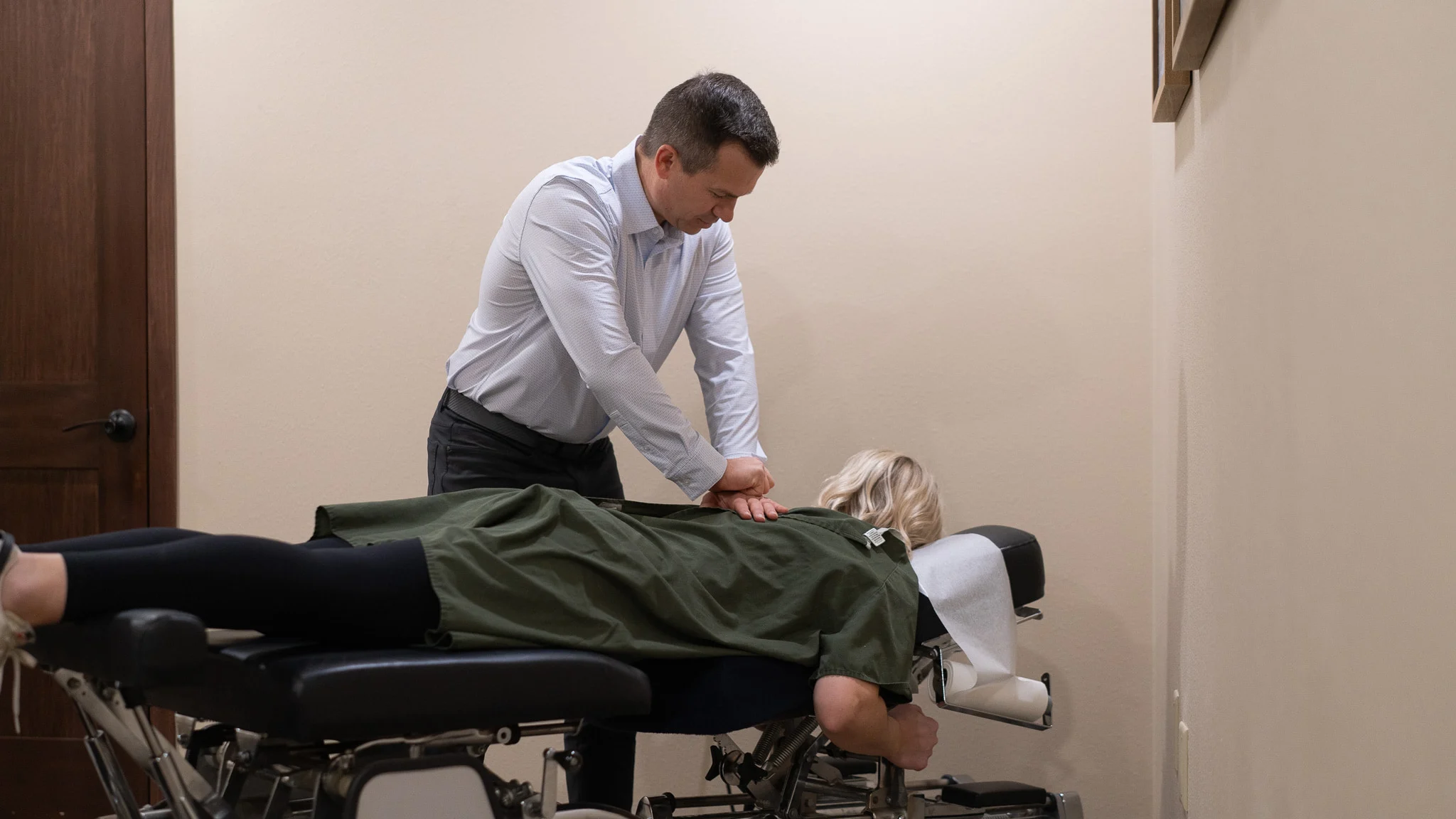
Chiropractic care centers on the relationship between the spine, the nervous system, and the body’s overall function. A chiropractor identifies and corrects misalignments in the spine that interfere with how the nervous system communicates with the rest of the body.
The primary tool is the chiropractic adjustment, a specific, controlled force applied to a joint to restore proper alignment and motion. At Leading Edge, Dr. Chad Updike and Dr. Katie Canar use the Gonstead method, which is a precise system for identifying exactly which segments need adjustment.
Chiropractic is especially effective for problems rooted in spinal misalignment and joint dysfunction, including back pain, neck pain, headaches, sciatica, and nerve compression. The goal is to correct the structural source of the problem so the body can function and heal properly.
What Physical Therapy Focuses On
Physical therapy centers on restoring movement, strength, and function, typically through exercise, stretching, and rehabilitation techniques. A physical therapist works to rebuild strength in weakened areas, improve flexibility, and retrain movement patterns.
Physical therapy is often used after surgery, after a significant injury, or to address weakness and mobility limitations. The emphasis is on active rehabilitation, guiding patients through exercises and movements that progressively rebuild capacity over time.
Where chiropractic focuses heavily on the structural alignment of the spine and joints, physical therapy focuses more on the muscular and functional side, strengthening and retraining the body to move well.
The Key Differences
Both disciplines care about helping you move and feel better, but their primary methods differ. Chiropractic emphasizes hands-on adjustment to correct structural alignment and relieve nerve interference. Physical therapy emphasizes guided exercise and rehabilitation to rebuild strength and function.
Chiropractic tends to be the stronger fit when the problem is driven by spinal misalignment, joint restriction, or nerve compression. Physical therapy tends to be the stronger fit when the problem is driven by muscular weakness, deconditioning, or the need to rehabilitate after an injury or surgery.
That said, this is not a rigid divide. Many conditions involve both structural and functional components, which is exactly why the two approaches often complement each other so well.
Why They Often Work Better Together
Here is something worth understanding. Chiropractic and physical therapy are not competitors, and choosing one does not mean rejecting the other. In many cases, the best results come from combining them.
Consider a common example. Someone has a spinal misalignment that is compressing a nerve and causing pain, and they have also developed muscular weakness and poor movement patterns as a result. Chiropractic care corrects the misalignment and relieves the nerve pressure. Physical therapy rebuilds the strength and retrains the movement. Together, they address both sides of the problem more completely than either could alone.
At Leading Edge Chiropractic, the focus is on what actually helps the patient. If someone would benefit from physical therapy alongside their chiropractic care, that is a conversation worth having. The two disciplines reinforce each other, and using them together often produces better and longer-lasting results.
How to Decide Where to Start
If you are trying to figure out where to begin, a few general guidelines help.
Chiropractic is often a good starting point when your pain involves the spine, when you have nerve symptoms like radiating pain or numbness, when you have headaches connected to your neck, or when you suspect a misalignment is driving the problem. It is also a good choice when you want to address the structural cause rather than just build strength.
Physical therapy is often the right starting point when you are recovering from surgery, when you have significant muscular weakness or deconditioning, or when a provider has specifically prescribed rehabilitation for your condition.
When you are not sure, a chiropractic evaluation can help clarify what is going on. Dr. Chad and Dr. Katie will assess your situation and give you honest guidance, including whether physical therapy or another approach might serve you better or complement your care.
The Leading Edge Approach
The philosophy at Leading Edge is that health is built through a whole-body approach, not a single technique. Chiropractic care is what the practice does, and it does it with precision through the Gonstead method. But the team also recognizes that chiropractic is one piece of a larger picture that can include movement, rehabilitation, nutrition, and more.
This is why patients throughout the La Crosse area appreciate the honest guidance they receive. The goal is never to insist that chiropractic is the only answer. It is to help each person find what will genuinely get them better, whether that is chiropractic care, a combination of approaches, or a referral when something else is needed.
Frequently Asked Questions
Can I do chiropractic and physical therapy at the same time?
Yes, and for many conditions this combination works very well. Chiropractic addresses the structural alignment while physical therapy rebuilds strength and function. The two complement each other, and doing them together often produces better results than either alone.
Which one is better for back pain?
It depends on what is causing the back pain. If it is driven by spinal misalignment or nerve compression, chiropractic is often the better fit. If it is driven by muscular weakness or requires rehabilitation, physical therapy may be more appropriate. Often a combination is ideal. An evaluation helps determine what your specific situation calls for.
Find Out What Will Actually Help You
If you are unsure whether chiropractic is the right fit for what you are dealing with, we are happy to give you honest guidance. Contact Leading Edge Chiropractic or call 608-526-2854 to schedule an evaluation in Holmen and get clarity on the right path forward.

Leading Edge Chiropractic serves Holmen, WI and the surrounding La Crosse area with precise, results-driven chiropractic care. Dr. Chad Updike and Dr. Katie Canar are both extensively trained in the Gonstead method, bringing a level of specificity and thoroughness to every patient that goes well beyond a standard adjustment. Dr. Chad serves as Team Chiropractor for the Holmen High School football team and has spent a decade on the board of the Chiropractic Society of Wisconsin, including two years as President. Dr. Katie graduated summa cum laude from Palmer College of Chiropractic, holds Webster Certification for prenatal care, and has completed hundreds of hours of advanced Gonstead training. Together they care for patients of all ages, from infants and student-athletes to active adults and seniors. If you’re ready to find out what’s actually driving your symptoms, contact Leading Edge Chiropractic today.